
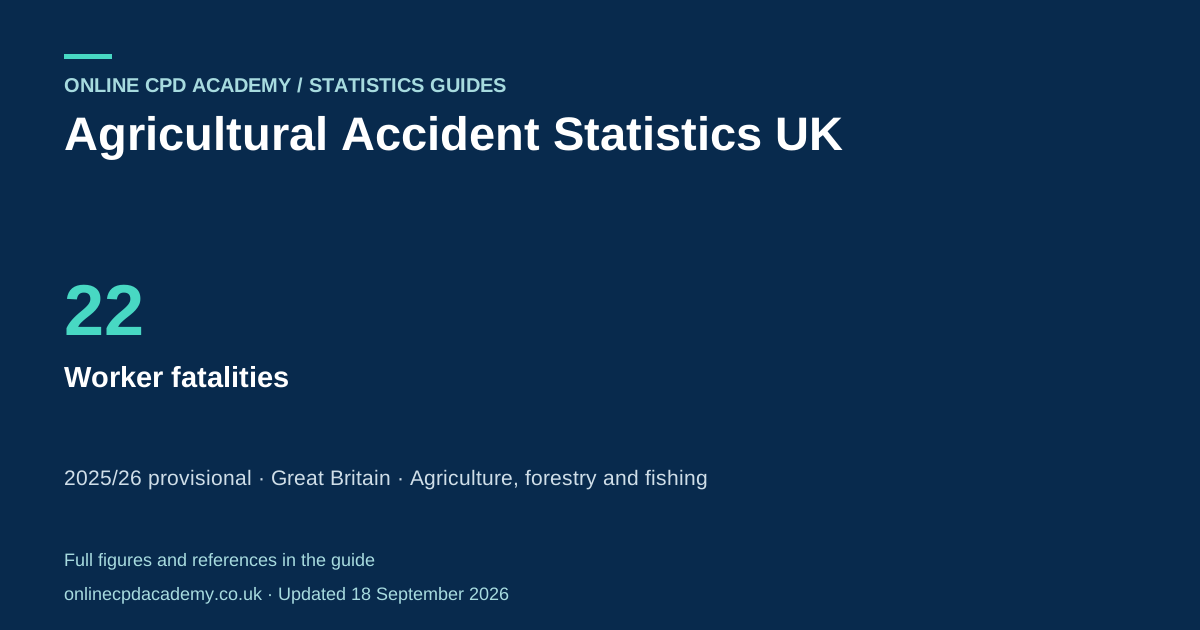
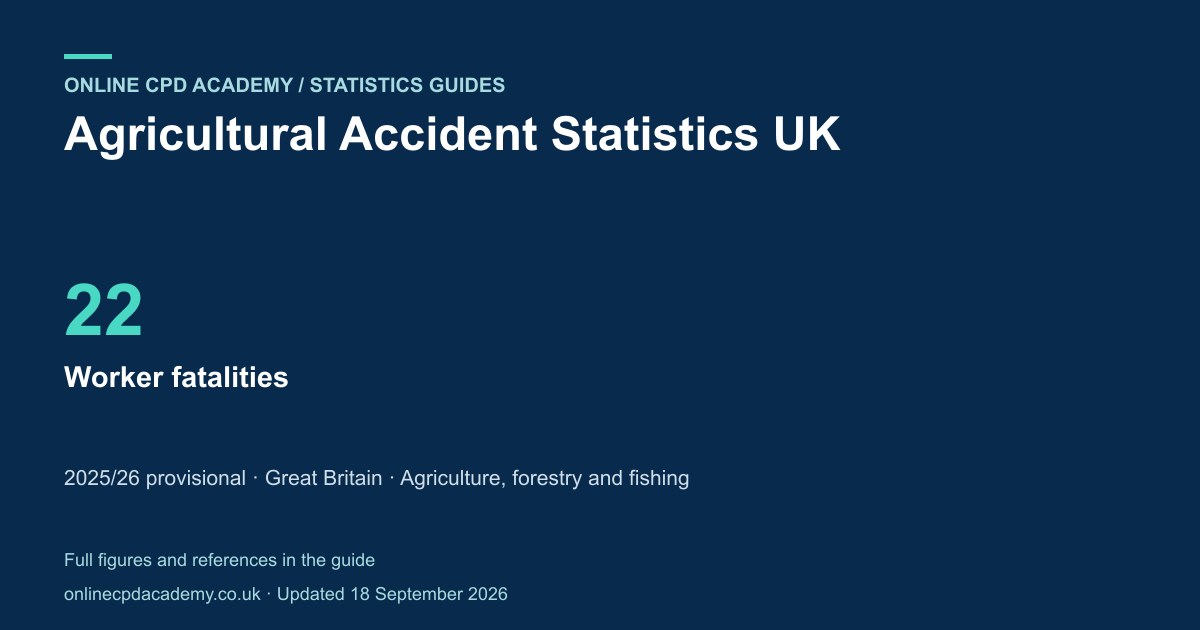
22 workers died in agriculture, forestry and fishing in Great Britain in 2025/26. Seven members of the public also died, including three children. HSE identifies the sector as having the highest worker fatal injury rate among the main industries.
Key statistics at a glance
| Statistic | Figure | Period and coverage |
|---|---|---|
| Worker fatalities | 22Agriculture, forestry and fishing | 2025/26 provisional Great Britain |
| Public fatalities | 7Includes three children | 2025/26 provisional Great Britain |
| Worker fatal injury rate relative to all industries | 21 timesHSE five-year rate comparison | Five years to 2025/26 Great Britain |
| Deaths involving moving or overturning vehicles | 8Agriculture, forestry and fishing | 2025/26 provisional Great Britain |
| Worker fatalities among people over 65 | Half | 2025/26 provisional Great Britain |
| Workers with self-reported non-fatal injury | 8,000 annual averageLabour Force Survey estimate | 2020/21–2024/25 Great Britain |
| Workers with work-related ill health | 9,000 annual averageNew and long-standing conditions | 2020/21–2024/25 Great Britain |
Great Britain. Latest official fatality figures for April 2025–March 2026, subject to revision. The fatal injury rate comparison covers five years; injury and ill-health estimates cover 2020/21–2024/25.
How many people die in agricultural accidents?
The 22 worker deaths and seven public deaths bring the sector’s total to 29 deaths in Great Britain in 2025/26. Worker deaths alone accounted for 17.5% of the 126 workplace fatalities recorded across all industries, calculated as 22 ÷ 126.
The figures cover agriculture, forestry and fishing. HSE’s series covers England, Scotland and Wales; Northern Ireland publishes separate figures.
Why is agriculture a high-risk industry?
Over the five years to 2025/26, HSE puts the sector’s worker fatal injury rate at 21 times the all-industry rate. Vehicles, falling objects, falls from height, animals and machinery feature among the leading hazards. Moving or overturning vehicles were involved in eight deaths in 2025/26.
The long-term fatal injury rate has generally fallen, but HSE’s 2025 sector report describes a flattening of progress in more recent years.
Older workers and children
People over 65 accounted for half of worker deaths in 2025/26. HSE also recorded nine child deaths over the previous five years, including three in 2025/26.
HSE’s farm-safety advice includes separating children from working areas, providing secure play spaces and controlling access to vehicle routes and machinery.
Non-fatal injuries and work-related ill health
An estimated 8,000 workers suffered a non-fatal injury each year, on average, over 2020/21–2024/25. A separate estimate puts work-related ill health at 9,000 workers a year, including both new and long-standing conditions. These Labour Force Survey estimates cover agriculture, forestry and fishing.
HSE uses a five-year average to improve the reliability of survey estimates for this relatively small sector. The figures describe a typical year across that period rather than a count for 2025/26.
What can farms do to reduce the risks?
Vehicle routes, reversing, machinery maintenance and access by children are practical priorities. HSE’s Safe Stop sequence is to apply the handbrake, put controls in neutral, stop the engine and remove the key. Maintenance may also need isolation and control of stored energy.
Our Risk Assessment Training covers the general process of identifying hazards and choosing controls. Farm-specific procedures should follow the relevant HSE guidance and equipment instructions.
Frequently asked questions
Is agriculture the most dangerous industry in Great Britain?
HSE identifies agriculture, forestry and fishing as the main industry sector with the highest worker fatal injury rate. The five-year rate to 2025/26 was 21 times the all-industry rate.
How many children died in agricultural incidents?
HSE recorded three child deaths in 2025/26 and nine over the previous five years in Great Britain.
Are the latest figures for the whole UK?
The HSE figures cover Great Britain. Northern Ireland has a separate regulator and statistical series.
Using these statistics?
Please credit Online CPD Academy and link to this guide when using these statistics in an article, report or website.
Suggested citation: Online CPD Academy, Agricultural Accident Statistics UK: 2025/26 HSE Figures, updated 18 September 2026.
Sources
- HSE — Work-related fatal injuries in Great Britain, 2025/26 provisional overview
- HSE — Farm Safety Week: children and older workers on Britain's farms
- HSE — Agriculture, forestry and fishing statistics in Great Britain, 2025
- HSE — Children and public safety in agriculture
- HSE — Using machines safely in agriculture
From food hygiene and fire safety to first aid, mental health and more, we offer a wide range of accredited, online courses you can start today.
Browse all 22 accredited courses →
Mark writes about workplace health and safety, compliance and accredited online training for Online CPD Academy. About Online CPD Academy.