

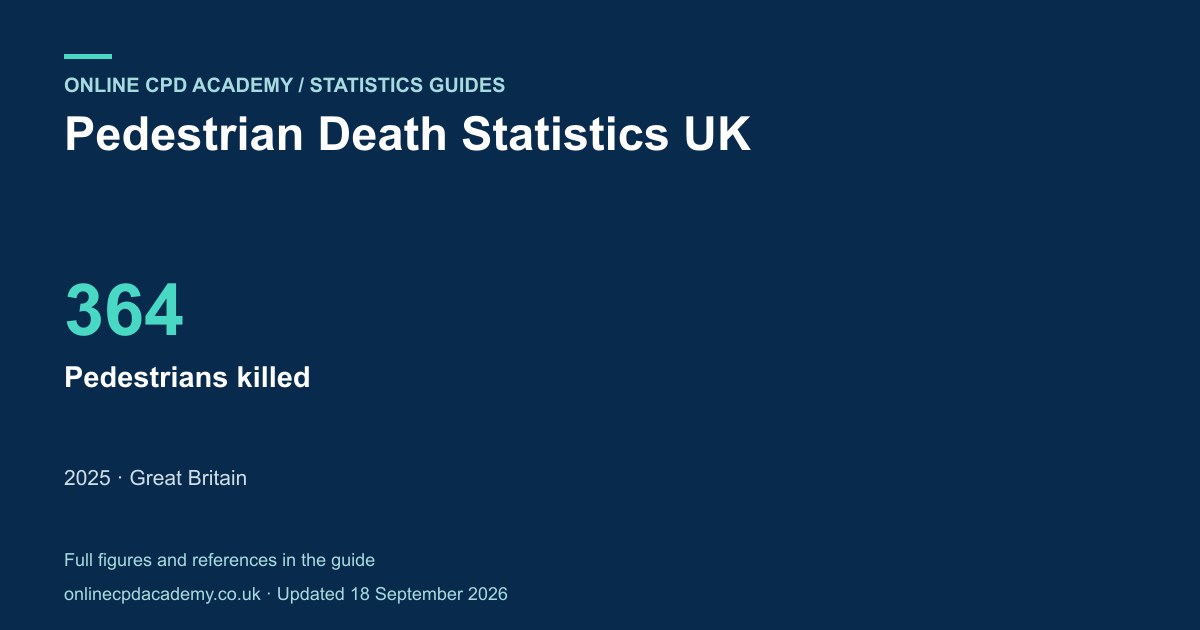
In 2025, 364 pedestrians were killed and 5,958 were seriously injured in police-reported road collisions in Great Britain. The total number of pedestrian casualties was 19,978. These are the DfT final results published in July 2026.
Key statistics at a glance
| Statistic | Figure | Period and coverage |
|---|---|---|
| Pedestrians killed | 364 | 2025 Great Britain |
| Seriously injured pedestrians | 5,958 | 2025 Great Britain |
| Slightly injured pedestrians | 13,656 | 2025 Great Britain |
| All pedestrian casualties | 19,978 | 2025 Great Britain |
| Change in fatalities | −11% | 2024 to 2025 Great Britain |
| Fatalities on rural roads | 30%Five-year pooled share; rural roads accounted for 12% of pedestrian casualties. | 2021–2025 Great Britain |
Great Britain; final 2025 police-reported casualties. Serious and slight injuries are severity adjusted. Some risk breakdowns pool 2021–2025. Standalone pedestrian falls are not included.
Have pedestrian deaths increased or decreased?
Pedestrian deaths fell from 409 in 2024 to 364 in 2025: 45 fewer people, or an 11% decrease after rounding. The 2025 total was also below the 470 deaths recorded in 2019.
Serious injuries moved in the other direction, rising from 5,723 in 2024 to 5,958 in 2025. These annual comparisons use the revised historical figures in the current DfT release.
Junctions, rural roads and vehicle involvement
Across 2021–2025, about 61% of pedestrian fatalities occurred away from junctions, defined as neither at a junction nor within 20 metres of one. About 54% occurred in collisions involving a single car.
Rural roads accounted for 30% of pedestrian fatalities but 12% of all pedestrian casualties over the five-year period. These pooled figures describe where recorded casualties occurred.
Do the figures include pavement trips and falls?
Standalone pedestrian trips and falls without vehicle involvement are outside this road-collision series. Pedestrian casualties in the guide are already included within DfT's overall road casualty totals.
The reporting system includes public highways and footways. A qualifying collision can involve a pedal cycle rather than a motor vehicle. Research into pavement falls and their health costs therefore requires a separate source from these road-collision statistics.
Understanding revised injury figures
DfT's original 2024 pedestrian factsheet reported 5,823 adjusted serious injuries. The July 2026 release revised that figure to 5,723. Comparisons with 2025 use the revised series.
Severity adjustments improve consistency between police reporting systems; they do not estimate injuries that were never reported. The published 2025 walking-distance rates also used 2024 travel data as a proxy because the new National Travel Survey was not yet available at publication.
Frequently asked questions
How many pedestrians were killed in Great Britain in 2025?
364 pedestrians died in police-reported road collisions, down 11% from 409 in 2024.
How many pedestrians were seriously injured in 2025?
The final severity-adjusted total is 5,958 serious injuries. There were 19,978 pedestrian casualties of all severities.
Are pedestrian casualties included in the national road total?
Yes. They form one road-user category within the DfT road casualty total. Standalone pedestrian trips and falls are outside that series.
Using these statistics?
Please credit Online CPD Academy and link to this guide when using these statistics in an article, report or website.
Suggested citation: Online CPD Academy, Pedestrian Death Statistics UK: 2025 Data & 2026 Update, updated 18 September 2026.
Sources
From food hygiene and fire safety to first aid, mental health and more, we offer a wide range of accredited, online courses you can start today.
Browse all 22 accredited courses →
Mark writes about workplace health and safety, road and transport risk, compliance and accredited online training for Online CPD Academy.