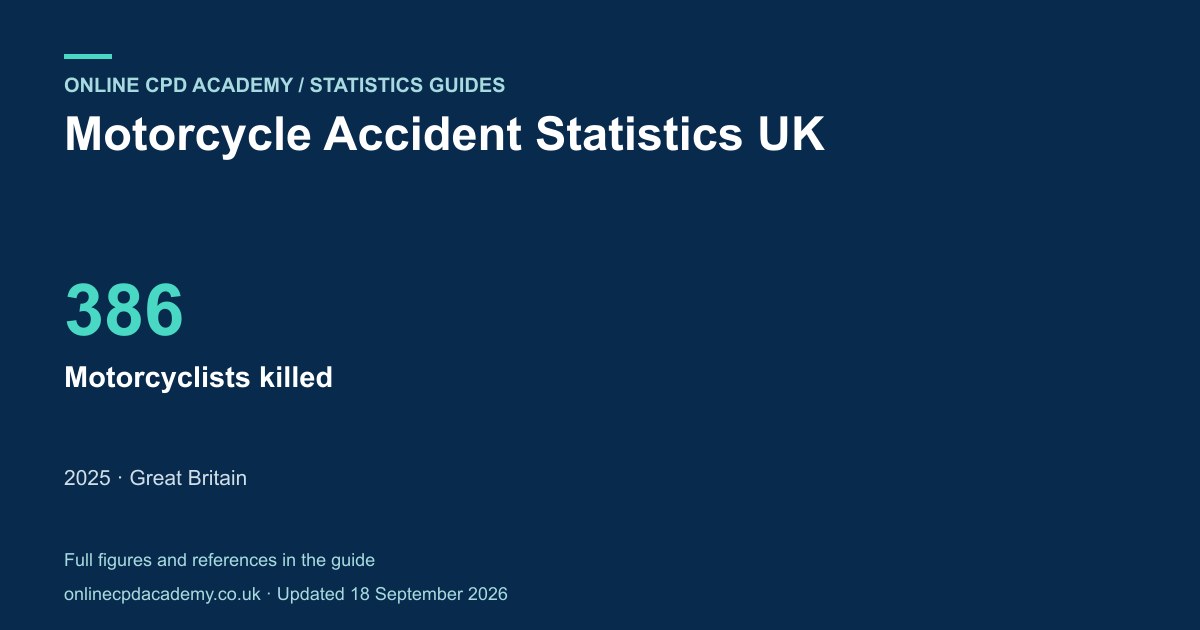
Motorcyclists are the most disproportionately at-risk road user group in the UK. In 2024, 340 motorcyclists were killed — representing 21% of all road fatalities despite motorcycles accounting for less than 1% of total road traffic. The fatality rate for motorcyclists is 115.2 deaths per billion miles — more than 42 times higher than for car occupants (2.7 per billion miles). Six motorcyclists die, on average, every single week in Great Britain.
And 2024 was a deteriorating year. Motorcyclist deaths rose 8% — the only major road user group to record an increase — at a time when overall road fatalities fell 1%.
Key facts and figures
- 340 motorcyclists killed in Great Britain in 2024 — up 8% from 315 in 2023 (DfT, September 2025).
- 5,468 seriously injured motorcyclists in 2024 (adjusted figure).
- 10,152 slightly injured motorcyclists in 2024.
- 21% of all road fatalities are motorcyclists, despite representing less than 1% of road traffic.
- 115.2 deaths per billion miles — 42 times higher than car occupants (2.7 per billion miles).
- ~50 times more likely to be involved in a fatal accident than car occupants.
- 92% of motorcycle KSI casualties are male — the most male-dominated fatal injury category of any road user group.
- 69% of fatalities occur on rural roads — disproportionate to the 40% of motorcycle traffic on those roads.
21% of road deaths, less than 1% of traffic
The single most important fact about motorcycle safety in the UK is one of disproportion. Motorcycles account for less than 1% of total road traffic, yet motorcyclists made up 21% of all road fatalities in 2024. No other road user group is killed so far out of step with how much it uses the road.
The gap is starkest in the per-mile fatality rate. At 115.2 deaths per billion miles, riding a motorcycle is more than 42 times more dangerous than travelling as a car occupant (2.7 per billion miles), and motorcyclists are roughly 50 times more likely to be involved in a fatal accident. In practical terms, six motorcyclists die on Great Britain's roads in an average week.
And 2024 was a year of deterioration rather than progress. Motorcyclist deaths rose 8% — the only major road user group to record an increase — even as overall road fatalities fell by 1%.
Key facts & figures (overview)
- 340 motorcyclists killed in Great Britain in 2024 — up 8% from 315 in 2023 (DfT, September 2025).
- 5,468 motorcyclists seriously injured in 2024 (adjusted).
- 10,152 motorcyclists slightly injured in 2024.
- Motorcyclists account for 21% of all road fatalities despite representing less than 1% of road traffic.
- The fatality rate for motorcyclists: 115.2 deaths per billion miles — 42 times higher than car occupants (2.7 per billion miles).
- Motorcyclists are approximately 50 times more likely to be involved in a fatal accident than car occupants.
- 92% of motorcycle KSI casualties are male — the most male-dominated fatal injury category of any road user group.
- 6 motorcyclists die every week on average and 102 are seriously injured per week (2019–2023 average).
- 69% of motorcycle fatalities occur on rural roads — disproportionate to the 40% of motorcycle traffic on rural roads.
- 38% of motorcycle fatalities involved a collision with a car.
- The highest proportion of motorcycle fatalities that are fatal relative to casualties occurs in HGV collisions (9.4% of motorcycle-HGV collisions result in death).
- Head and chest injuries are the main causes of death of motorcyclists.
- The most common road safety factor in motorcyclist fatal/serious collisions: "ineffective observation" — both by the motorcyclist and by other vehicle drivers.
- On motorways: motorcycle fatality rates (3%) are lower than traffic share (6%) — motorways are relatively safer for motorcyclists.
- In the 20-year period 2004–2024: motorcycle traffic decreased 6% but the overall casualty rate decreased 27% and fatality rate decreased 40%.
- Peak weekend times for motorcycle KSIs: Saturday and Sunday early afternoon (12 noon to 4pm) — the leisure riding profile.
- Weekday peak for motorcycle KSIs: morning (7–10am) and evening (4–7pm) commuter patterns.
| Measure (Great Britain, 2024) | Figure | Change vs 2023 |
|---|---|---|
| Motorcyclists killed | 340 | ▲ 8% |
| Seriously injured (adjusted) | 5,468 | — |
| Slightly injured | 10,152 | — |
| Share of all road fatalities | 21% | <1% of traffic |
| Fatality rate (per billion miles) | 115.2 | 42× car occupants |
| KSI casualties that are male | 92% | — |
Why motorcyclists are so vulnerable
The data shows motorcyclists are killed and seriously injured far out of proportion to how much they use the roads. Several factors combine to make a powered two-wheeler one of the most dangerous ways to travel:
- No protective structure: A car occupant in a collision has crumple zones, airbags, seatbelts, and a steel cage. A motorcyclist has personal protective equipment (PPE) — helmet, gloves, jacket, boots — which can significantly reduce injury severity but cannot replicate the passive safety protection of a vehicle body.
- Visibility: Motorcycles have a smaller visual footprint than cars and are frequently overlooked by other road users at junctions and when turning. "Looked but failed to see" is the most commonly cited factor in car-motorcycle collisions. The motorcycle's narrow profile means it can be obscured by the A-post of a car or blend into a busy background.
- Speed differential: At higher speeds, collisions involving motorcycles are more likely to be fatal. Rural roads — where motorcyclists are overrepresented — combine higher speeds with junctions and bends where visibility is reduced.
- The leisure riding profile: A significant proportion of motorcycle journeys — particularly at weekends and during summer — are leisure rides rather than commuter trips. Leisure riding creates specific risk factors: unfamiliar routes, higher average speeds, sustained concentration demands on longer journeys.
- HGV interaction: The 9.4% fatality rate in motorcycle-HGV collisions (compared to 3–4% for motorcycle-car collisions) reflects the catastrophic physics of a motorcycle colliding with a heavy goods vehicle. London's DVS scheme, which has dramatically reduced HGV-related KSIs in the capital, demonstrates the potential for targeted intervention.
The role of protective equipment
With no surrounding bodywork to absorb a crash, what a rider wears is often the difference between a survivable incident and a fatal one. The evidence is clearest for helmets:
- Helmets: Head and chest injuries are the main causes of motorcycle deaths. A well-fitted, certified helmet is the single most important factor in survivability. The government's SHARP (Safety Helmet Assessment and Rating Programme) rates helmets on a 1–5 star safety scale. Research indicates that wearing a five-star rated helmet significantly reduces the risk of fatal or serious head injury compared to lower-rated models. Every rider has a legal obligation to wear an approved helmet under the Motor Cycles (Protective Helmets) Regulations 1998.
- Motorcycle clothing: While not legally mandated in the same way as helmets, protective clothing (CE-rated jackets, trousers, gloves, boots) significantly reduces abrasion injuries in slides — which are a major mechanism of injury in non-fatal motorcycle accidents.
Employer and fleet implications
For organisations whose employees ride motorcycles for work — courier services, emergency services, some healthcare and utilities roles — motorcycle risk is a workplace safety issue. The Health and Safety at Work Act 1974 requires employers to manage this risk. Fleet policies must address motorcycle safety standards, mandatory training (CBT, full licence categories), and PPE requirements for riders.
Many employers fold work-related road risk into wider workplace safety training. Our Risk Assessment Training and Manual Handling Training help managers identify and control the human and procedural risks that sit behind statistics like these.
Written by CPD experts
This guide was produced by the team at Online CPD Academy, a UK provider of CPD-accredited online training courses. Our Driver CPC and work-related road risk training covers all vehicle types including powered two-wheelers, fleet safety obligations, and vulnerable road user awareness.
Sources & references
- DfT / Gov.UK – Reported Road Casualties Great Britain: Motorcyclist Factsheet 2024 (September 2025)
- DfT / Gov.UK – Reported Road Casualties Great Britain, Annual Report 2024
- Motorcycle News – Motorcycle Fatalities Rise Despite Safer UK Roads (October 2025)
- SHARP – What Do the Latest Road Casualty Statistics for Motorcyclists Tell Us? (November 2024)
- BRAKE – UK Collision and Casualty Statistics
From food hygiene and fire safety to first aid, mental health and more, we offer a wide range of accredited, online courses you can start today.
Browse all 22 accredited courses →