
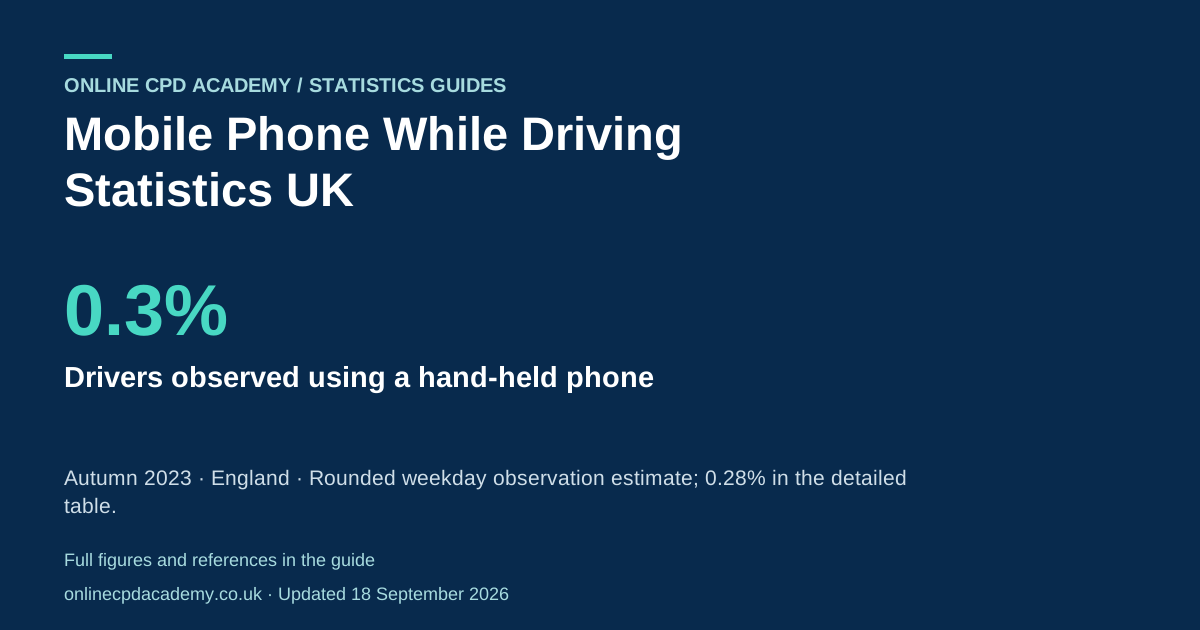
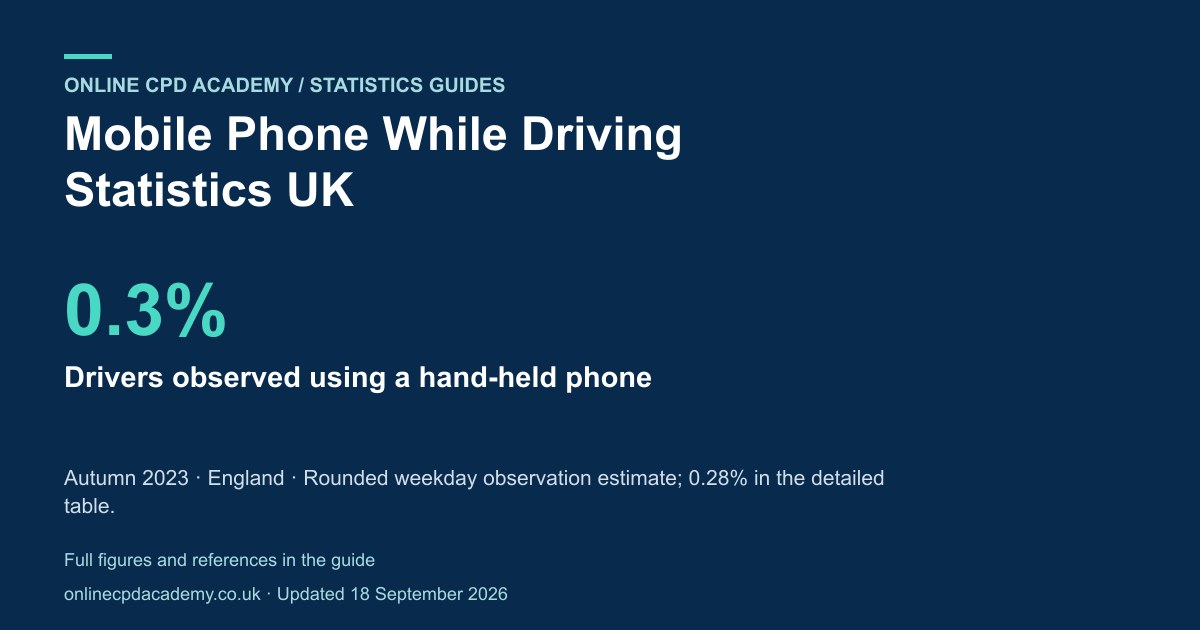
In England, 0.3% of drivers were observed using a hand-held phone in the autumn 2023 roadside survey. A separate survey found that 4.3% of drivers in England and Wales reported hand-held phone use during the year ending March 2025.
Key statistics at a glance
| Statistic | Figure | Period and coverage |
|---|---|---|
| Drivers observed using a hand-held phone | 0.3%Rounded weekday observation estimate; 0.28% in the detailed table. | Autumn 2023 England |
| Van drivers observed using a hand-held phone | 0.6%Rounded; detailed estimate 0.62%. | Autumn 2023 England |
| Car drivers observed using a hand-held phone | 0.2% | Autumn 2023 England |
| Drivers self-reporting phone use held in the hand | 4.3%Use in the previous 12 months, not at one instant. | Year ending March 2025 England and Wales |
| Fatal collisions with mobile-device factor | 32Subset of 996 fatal collisions; factor can apply to drivers or pedestrians. | 2025 Great Britain |
| Share of analysed fatal collisions with mobile-device factor | 3.2%32 / 996, rounded; not share of all road deaths. | 2025 Great Britain |
England observational survey (2023), England and Wales self-reported survey (year ending March 2025), and a Great Britain road safety factor subset (2025).
Observed and self-reported phone use
The England roadside survey observed hand-held phone use by 0.3% of drivers in autumn 2023. The rounded rates were 0.6% for van drivers and 0.2% for car drivers.
The Crime Survey for England and Wales found that 4.3% of drivers reported using a phone held in the hand during the previous 12 months, for the year ending March 2025. Observation measures use at the moment sampled; the survey measures whether someone used a phone at any point over a year.
The 2023 observation study used images from 25 sites and introduced a different collection method, limiting direct comparison with earlier observation surveys.
Mobile-device factors in fatal collisions
Mobile-device use was recorded as a factor in 32 of the 996 fatal collisions in DfT's analysed 2025 road safety factor dataset, equivalent to 3.2% after rounding.
The factor can apply to a driver, casualty or uninjured pedestrian. It records the attending officer's assessment of circumstances that may have contributed, and covers the relevant RSF subset of collisions. Several factors can be assigned to the same event.
The law and penalties
Using a hand-held phone or similar device while driving can bring six penalty points and a £200 fine. Exceptions include an emergency call to 999 or 112 when stopping is unsafe or impractical, contactless payment while stationary and remote parking.
Hands-free equipment must not obstruct the driver's view, and the driver must remain in control. Hands-free calls can still create distraction, so legal use requires attention to the driving situation.
Phone use during work journeys
Employers can plan communications so staff can stop safely before dealing with calls or messages. Contact arrangements, realistic journey schedules and clear expectations belong in the driving-for-work risk assessment. Providing a hands-free kit alone does not resolve distraction risk.
Frequently asked questions
How many drivers are observed using a hand-held phone?
The autumn 2023 England survey observed hand-held phone use by 0.3% of drivers, including 0.6% of van drivers and 0.2% of car drivers.
How many drivers report using a hand-held phone over a year?
4.3% of drivers in England and Wales reported doing so during the previous 12 months in the survey for the year ending March 2025.
How often was mobile-device use recorded in fatal collisions?
It was recorded in 32 fatal collisions, or 3.2% of the analysed 2025 RSF dataset. The factor can apply to drivers or pedestrians.
Using these statistics?
Please credit Online CPD Academy and link to this guide when using these statistics in an article, report or website.
Suggested citation: Online CPD Academy, Mobile Phone While Driving Statistics UK (2026), updated 18 September 2026.
Sources
From food hygiene and fire safety to first aid, mental health and more, we offer a wide range of accredited, online courses you can start today.
Browse all 22 accredited courses →
Mark writes about workplace health and safety, compliance and accredited training for Online CPD Academy, the UK's leading online training company.