
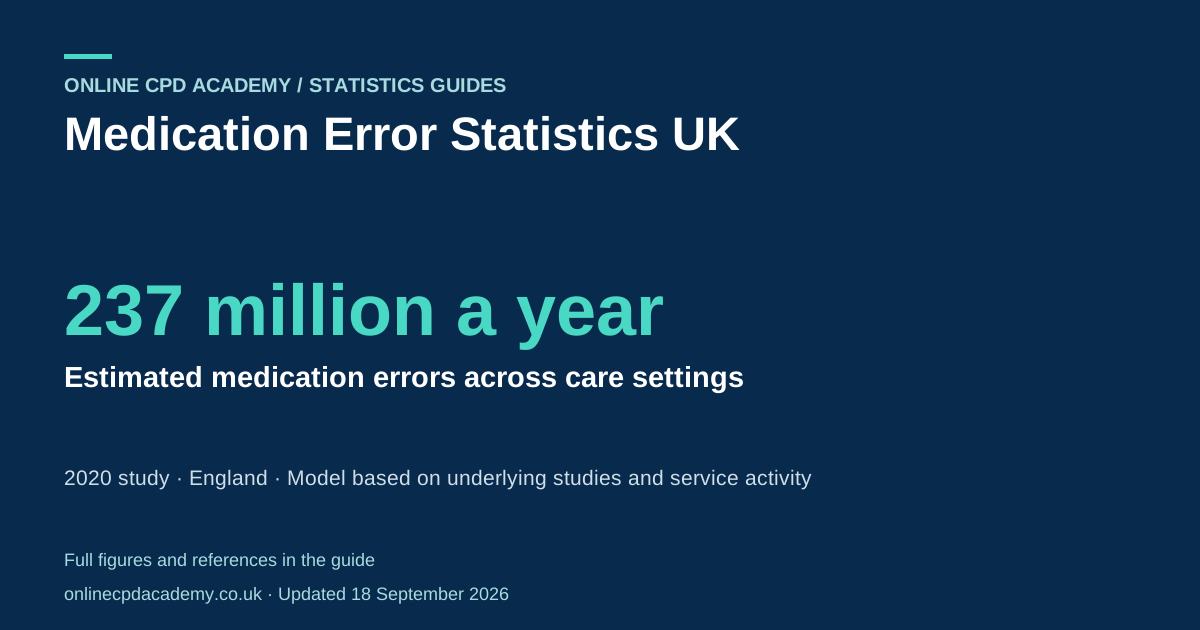
A national model estimates 237 million medication errors annually in England, including about 66 million with potential for clinically significant harm. Newer research on hospital transitions estimates 1.8 million undetected errors a year at admission, discharge and transfers.
Key statistics at a glance
| Statistic | Figure | Period and coverage |
|---|---|---|
| Estimated medication errors across care settings | 237 million a yearModel based on underlying studies and service activity, not incident-report count. | 2020 study England |
| Errors potentially causing moderate or severe harm | About 66 million a yearPotential harm does not mean an injury occurred. | 2020 study England |
| NHS cost of definitely avoidable adverse drug events | £98.5 million a yearHistorical modelled estimate, not current-price expenditure. | 2020 study model England |
| Deaths to which definitely avoidable adverse drug events contributed | 1,708 a yearModelled contribution; not individually confirmed error-caused deaths. | 2020 study model England |
| Undetected hospital-transition errors | 1.8 million a year95% credibility interval: 1.3–2.6 million. | 2024 study England |
| Patients experiencing harm from those transition errors | About 31,500 a yearModelled; not additional to the entire national burden estimate. | 2024 study England |
The national estimate was published in 2020; the hospital-transition model in 2024. Both cover England and use modelling, with different and partly overlapping scopes.
How many medication errors occur?
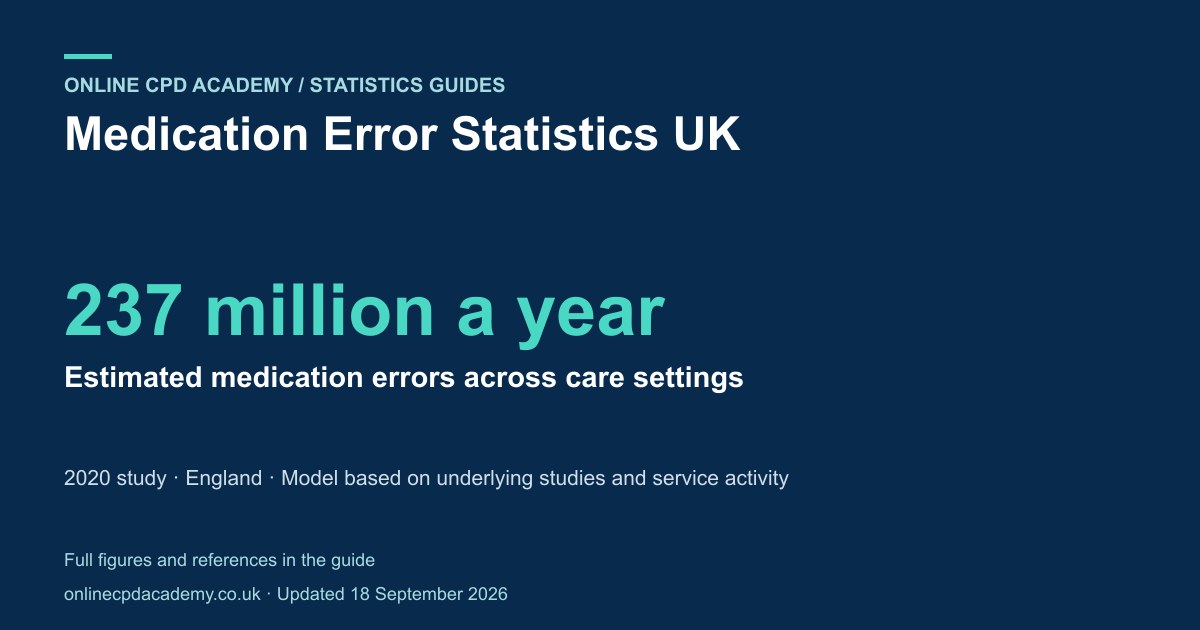
The broad national model estimates 237 million errors a year across prescribing, supplying, administering and monitoring medicines in England. Around 66 million had potential for moderate or severe clinical harm.
An error is a preventable problem in the medication process. It may be detected before reaching a patient, and a person can experience more than one error. An adverse drug event measures harm associated with a medicine; the relationship between errors and harm depends on the circumstances.
Where do medication errors happen?
The model assigned 41.7% of errors to care homes, 38.4% to primary care and 19.9% to secondary care. By stage in the process, administration accounted for 54.4% and prescribing for 21.3%.
Setting and process are separate breakdowns. Their shares reflect both error rates and how often medicines are prescribed, supplied or administered; they describe the modelled distribution of errors rather than a patient’s individual risk.
Medication-related harm, deaths and NHS costs
The study estimated that definitely avoidable adverse drug events cost the NHS approximately £98.5 million a year and contributed to 1,708 deaths. These are modelled consequences using evidence and assumptions about avoidable harm.
The model also explores less conservative scenarios. Its main estimates provide a consistent basis for describing the burden, while their uncertainty reflects gaps in the underlying evidence.
Errors when patients move between services
A 2024 study modelled undetected errors at hospital admission, discharge and transfers. It estimated 1.8 million errors annually, with a 95% credibility interval of 1.3–2.6 million, affecting about 380,000 patient episodes.
Estimated consequences included approximately 31,500 patients harmed, 36,500 additional bed-days and £17.8 million in NHS costs at 2020/21 prices. Around 52% of transition errors occurred at admission and 44% at discharge. Transitions involving care homes and mental-health facilities were outside this model.
How incident reporting differs from modelled estimates
NHS England’s Learn from Patient Safety Events service replaced the National Reporting and Learning System, which closed on 30 June 2024. Reporting changed as organisations moved to the newer system.
Incident reports describe events submitted to a reporting service. Modelling estimates a wider burden from several sources. Changes in reporting coverage, practice or systems can affect the number of reports independently of changes in safety.
A practical example: dose-frequency errors
MHRA warns that taking a once-weekly methotrexate regimen daily can cause fatal overdose. For autoimmune diseases the prescribed schedule is weekly, while cancer regimens can differ.
The warning identifies risks across prescribing, dispensing, communication and transfers of care. Clear dose-frequency information and a shared understanding of the treatment are therefore important throughout the medication process.
Frequently asked questions
How many medication errors occur each year?
A national model published in 2020 estimated 237 million errors annually in England. It includes errors across several care settings and stages of medication use.
How many medication errors could cause serious harm?
About 66 million of the modelled annual errors had potential for moderate or severe clinical harm. Potential harm differs from harm that actually occurred.
What is the estimated NHS cost of medication errors?
The national model estimated £98.5 million annually for definitely avoidable adverse drug events. A separate 2024 hospital-transition model estimated £17.8 million at 2020/21 prices; the scopes overlap and should remain separate.
Using these statistics?
Please credit Online CPD Academy and link to this guide when using these statistics in an article, report or website.
Suggested citation: Online CPD Academy, Medication Error Statistics UK: Errors, Harm and NHS Costs, updated 18 September 2026.
Sources
- Elliott et al. — Economic analysis of medication error in England, BMJ Quality & Safety
- PubMed — Elliott et al. national medication-error model
- Camacho et al. — Digital transfer of prescription information in the English NHS
- BMJ Group — Explanation of the 2024 hospital-transition modelling study
- NHS England — NRLS to LFPSE Transition Report, January 2021 to December 2024
- MHRA — Once-weekly methotrexate: avoiding inadvertent daily dosing
- BMJ Group — Explanation of the 2020 national medication-error model
From food hygiene and fire safety to first aid, mental health and more, we offer a wide range of accredited, online courses you can start today.
Browse all 22 accredited courses →
Mark writes about workplace health and safety, compliance and accredited online training for Online CPD Academy. About Online CPD Academy.